
The $500 Contract With a $1 Million Catch.
How a single clause strips your copyright, kills your income, and hands you the legal bill. And what you can do about it right now.
Update as of March 6, 2026: WSJ raised the freelance day rate to $650 after collective pressure. The Work Made for Hire clause remains in place. The organizing group still does not recommend signing. If you already signed and want to explore revocation, fill out the survey at https://forms.gle/CjnspyJXqRH69uAg7 and the revocation template will be sent to you.
On March 3, 2026, News Corp confirmed a deal with Meta worth up to $50 million per year to license content for AI training. That follows a reported $250 million agreement with OpenAI and a separate deal with Microsoft. The New York Times has also entered its own AI licensing arrangement with Amazon.
The question freelancers should be asking is simple: whose work is being licensed, and who gets paid when it is?
For visual freelancers working with The Wall Street Journal and Dow Jones, that question matters right now. The company's new freelance agreement does more than set a day rate. It changes who owns the work, who controls downstream use, and who carries the legal risk if something goes wrong.
That is why this contract fight is not just about $500 versus $650. It is about whether freelance creators keep any claim to the long-term value of the work they produce.
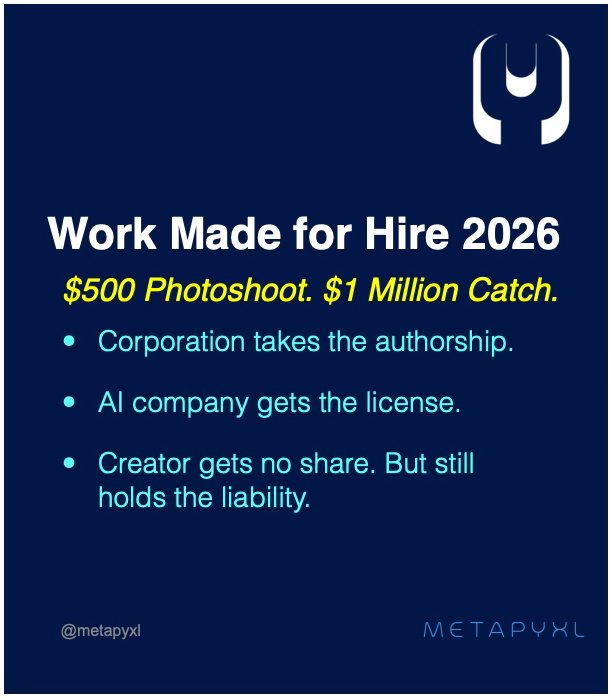
The $500 Contract With a $1 Million Catch.
If You Already Signed
If you signed the new WSJ contract because the rate increase made it seem acceptable, do not assume the story ends there. Organizers tracking the collective response are gathering names from photographers who want to explore revocation in light of the newly announced AI licensing deal. Fill out the survey at https://forms.gle/CjnspyJXqRH69uAg7.
At minimum, treat this as a moment to re-read what you signed and understand what rights may have been transferred.
The Clause That Changes the Economics
The most important issue in the contract is the Work Made for Hire language.
Under that structure, the publisher is not merely licensing your work for limited editorial use. It is claiming authorship status for the commissioned material from the outset. That means the company, not the photographer, controls future licensing, reuse, and monetization.
For a freelancer, that changes the economics completely.
A day rate pays for the assignment in front of you. Copyright is what creates value after the assignment is over. It is what allows an image to be syndicated, relicensed, archived, or otherwise monetized over time. Remove that, and the relationship stops being an investment in a body of work. It becomes a one-time transaction.
That matters because long-tail licensing income is not theoretical. It is one of the few ways freelancers build stability across slow periods, uneven assignment flow, and rising operating costs. If a photographer does 50 assignments a year at $500, that is $25,000 in direct fees. But the future licensing value of those images may be what makes that relationship financially sustainable at all.
A $150 rate increase does not replace the loss of those rights. It simply raises the upfront price of giving them away.
Rights Gone, Risk Left Behind
The contract problem is not only about ownership. It is also about exposure.
The indemnification language places significant legal responsibility on the freelancer if claims arise from the work. That could mean a creator is drawn into disputes far beyond the value of the original assignment fee.
The risks are real and specific: copyright claims over artwork or trademarks visible in an image, right of publicity claims over a subject's likeness, defamation or false light disputes if an image is reused in a misleading context, emerging AI training claims as that legal landscape develops, and model or property release disputes triggered by downstream commercial use. Under a Work Made for Hire structure, Dow Jones may control the defense while the freelancer remains exposed to the costs.
You give up the asset. You keep the risk.
Why the AI Deals Change Everything
This would already be a serious contract issue without AI. But the AI context raises the stakes dramatically.
When a media company enters licensing deals worth tens of millions of dollars for training data, archives become infrastructure. Photographs are no longer just illustrations attached to stories. They become inputs in a much larger commercial system, and that includes work made by freelance creators.
If the contract gives the publisher full control over the images, the publisher can include that work in broader AI licensing arrangements without seeking additional consent from the photographer and without sharing additional revenue. That is the practical concern at the center of this dispute.
The value of rights is no longer limited to print, web, or syndication. It now extends into large-scale AI licensing markets that most creators never had the chance to negotiate for.
What the Law Still Recognizes
On March 2, 2026, one day before the Meta deal was announced, the U.S. Supreme Court declined to hear Thaler v. Perlmutter, leaving in place the principle that works created solely by AI are not protected by copyright under current U.S. law. Human authorship remains the foundation.
That should reinforce the value of the photographer's role. A real person made the choices, framed the image, built trust with subjects, and created the work. That human contribution is exactly what the law continues to recognize as essential.
But a contract can still reallocate the rights and economic benefit associated with that authorship. That is the contradiction freelancers are being asked to live with. The legal system still depends on human creators. The contract structure is increasingly designed to separate those creators from the value of what they make.
Why This Is Bigger Than Income
News photography documents protests, vulnerable communities, conflict, grief, identity, and political life. When that archive is repurposed as AI training material, the issue is not only money. It is consent, context, and trust.
People agree to be photographed in one setting for one reason. They do not necessarily understand that those same images may later become part of large-scale machine learning systems. Photographers build access and credibility with subjects under conditions that are already fragile. Expanding the downstream use of those images without meaningful creator control can damage that trust and ultimately the integrity of the documentary record itself.
Visual journalism has long been treated as evidence, record, and witness. When the same archive is absorbed into systems designed to generate synthetic media, the line between documentation and simulation becomes harder to defend.
The Real Problem Is Infrastructure
At the center of all this is an infrastructure failure.
Once rights are stripped from the creator, the file moves through the world detached from clear authorship, usage terms, consent history, and licensing boundaries. Whoever controls the archive controls the next decision. That is how major downstream deals can happen without the creator being notified, consulted, or compensated.
Freelancers have been told for years to protect themselves through negotiation alone. But negotiation is weak protection when the systems around the work are built to separate the file from the creator. What creators need is infrastructure that keeps rights, provenance, and permissions connected to the work itself.
What Metapyxl Does About It
Metapyxl was built around a simple principle: rights travel with the file.
That means embedding authorship, licensing terms, provenance, and usage preferences into the asset itself, rather than relying on those protections to survive inside disconnected contracts, inboxes, and spreadsheets.
Metapyxl Vault is your content command center. Upload from anywhere and the platform auto-attaches metadata, signed license agreements, forensic watermarking, and C2PA provenance to every file. AI opt in and opt out is a creator-controlled setting embedded in the asset itself, not something determined by whoever holds the contract that day. Vault tracks downloads, monitors compliance, and sends real-time infringement notifications so you know when your work is being used without permission.
Metapyxl Lens is your verified public storefront. Clients can see your authenticity, rights, and usage terms at a glance. Licensing is instant. Every term of engagement is set by you from the start.
The visual professionals navigating these contract issues right now are exactly who Metapyxl is designed to serve. We are also building with creator input, because the people living this problem should shape the solution.
What to Do Right Now
Add your name to the collective response letter at http://bit.ly/WSJresponseletter and read the broader organizing context at aPhotoEditor.
If you already signed, fill out the revocation survey at https://forms.gle/CjnspyJXqRH69uAg7.
Do not rely on verbal assurances from editors. In a dispute, what matters is the written agreement and the rights structure it creates.
The real fight is no longer just about the fee. It is about whether your authorship, your leverage, and your future income remain attached to the work after it leaves your hands.